A first love is often one of our strongest. We fall giddily head over heels. Our love can do no wrong. We have no doubts. We are oblivious to any shortcomings of the object of our love.
My first love was flying and all to do with it. From age 10, I was busily building Airfix model plane kits and nagging my mum to drive me to airports during school holidays so I could lean over fences and dream. I devoured countless books, magazines and films on aviation. My bedroom walls were plastered with posters of aeroplanes.
In my late teens I commenced flying lessons, embarking on what would ultimately become a 40 year career in the industry. Whilst working for a regional airline in the late 1980s, I became aware of what at the time was somewhat quaintly called, “the greenhouse effect”. Now known as climate change or global warming, the knowledge that the burning of fossil fuels would increase atmospheric temperatures became widespread.
Like many, I only vaguely made the connection between my work and the impending changes in the climate. Yes, I burnt jet fuel for a living, but surely the bad guys were the coal fired power stations and heavy industry, not me flying to Albury or Mount Gambier.
But over time the whispering doubts about my first love became louder. I could see the efforts being made to decarbonise land based transport through electric vehicles and active transport options. I could see the decline of coal and gas fired power commence as mass solar and battery arrays began to supplement and then replace 19th century technology.
I tried to find out what the airline industry was doing to reinvent itself for a carbon constrained future and realised that my first love wasn’t being entirely truthful to me. My first love was attempting to conceal some dirty secrets.
Whilst aviation was reassuring me that everything was ok, they had everything under control and there was nothing to worry about, a different picture was clearly emerging and it wasn’t pretty.
Yes, the airline industry is slowly moving towards marginally more fuel efficient aircraft. What they don’t want you think about is that emissions from planned airline growth will totally swamp any small efficiency gains.
Yes, the airline industry is beginning to implement supposedly lower impact technology such as so called “sustainable aviation fuel” or SAF. What they don’t want to you consider is that there will never be anywhere near enough arable land or electricity generation capability for any of them at the scale required.
Yes, the industry is working to improve efficiency in the air through direct tracking and better traffic management to reduce airborne holding time. What they don’t want you to know is that these are marginal tinkering gains at best.
Last year (2025) I wrote to the CEO of my employer (part of Australia’s largest airline group), challenging the company’s approach to climate change and the contradiction between their growth pathway and climate reality.
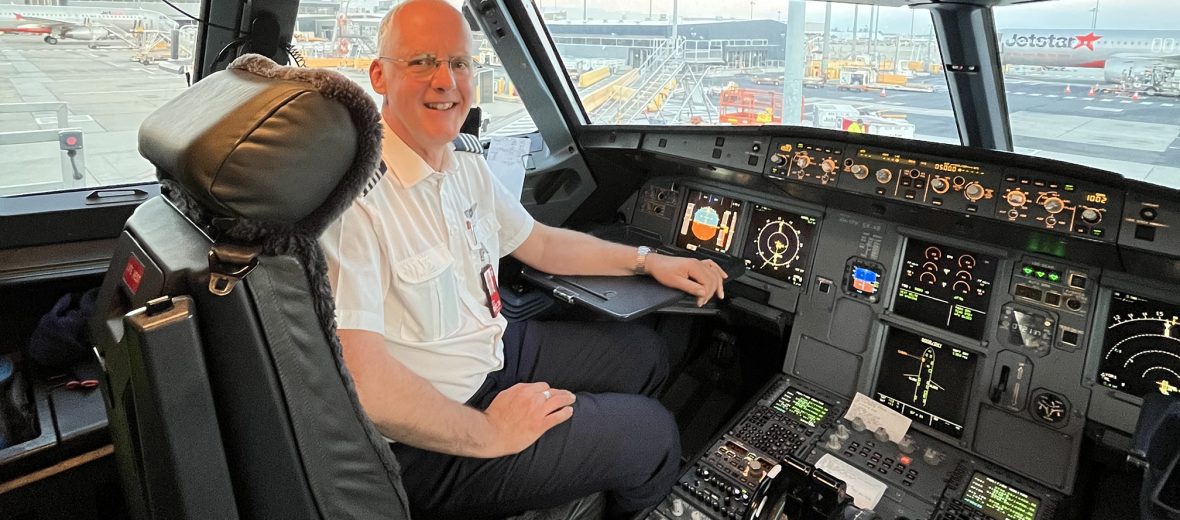
With over 25000 flying hours in my log book, I likened the company’s trajectory to one of ignoring multiple cockpit warnings and cautions that are getting louder, and pushing on into severe unsafe weather in the hope that something will change, rather than entering a holding pattern until conditions improve.
The reply offered to me as a 20 year senior Captain read like an AI generated press release, loaded with platitudes and warm fuzzy reassurances.
Mid last year I met with the Chief Sustainability Officer of Australia’s largest airline to continue to raise my concerns. Whilst they were no doubt sincere in their values, the corporate juggernaut they are part of continues to push the lie that we can have it all – limitless air travel and a habitable planet.
After 40 years, flying an aeroplane still gave an incomparable personal buzz, but I could no longer ignore the personal and planetary cost of what I did everyday. It was time to leave what was becoming a toxic relationship.
Breaking up with aviation was something that occurred gradually, but finally came with a rush and was easy. Once you start to question the industry’s approach to climate change, you don’t have to dig very deep to realise that it is little beyond enough tokenism and greenwashing to try to make you look away, while they continue push on with business as usual.
— Geoff Collis